Back to Notebook

Engineering Notebook ยท Product Development

Building an Engineering Portfolio as a Product

A purpose-built system for communicating complex engineering work to recruiters, technical leaders and senior engineers, using different levels of depth for each reader.

This is not a template website. Its information architecture, user experience, interface design, visual language, editorial system, software architecture and implementation were developed specifically for this portfolio. The project treats communication as a systems problem: identify the stakeholders, define what each reader must understand, select the simplest maintainable architecture and preserve evidence behind every major claim.

Active development

Type

Product Development

Status

Active development

Organisation

Independent engineering portfolio

Period

Active development

Technologies

  • Next.js
  • React
  • TypeScript
  • Tailwind CSS
  • Information Architecture
  • UX/UI Design
  • Content Architecture
  • Publication Safety
  • Repository Governance
  • Progressive Disclosure
  • Static Editorial Content
  • AI-Assisted Development

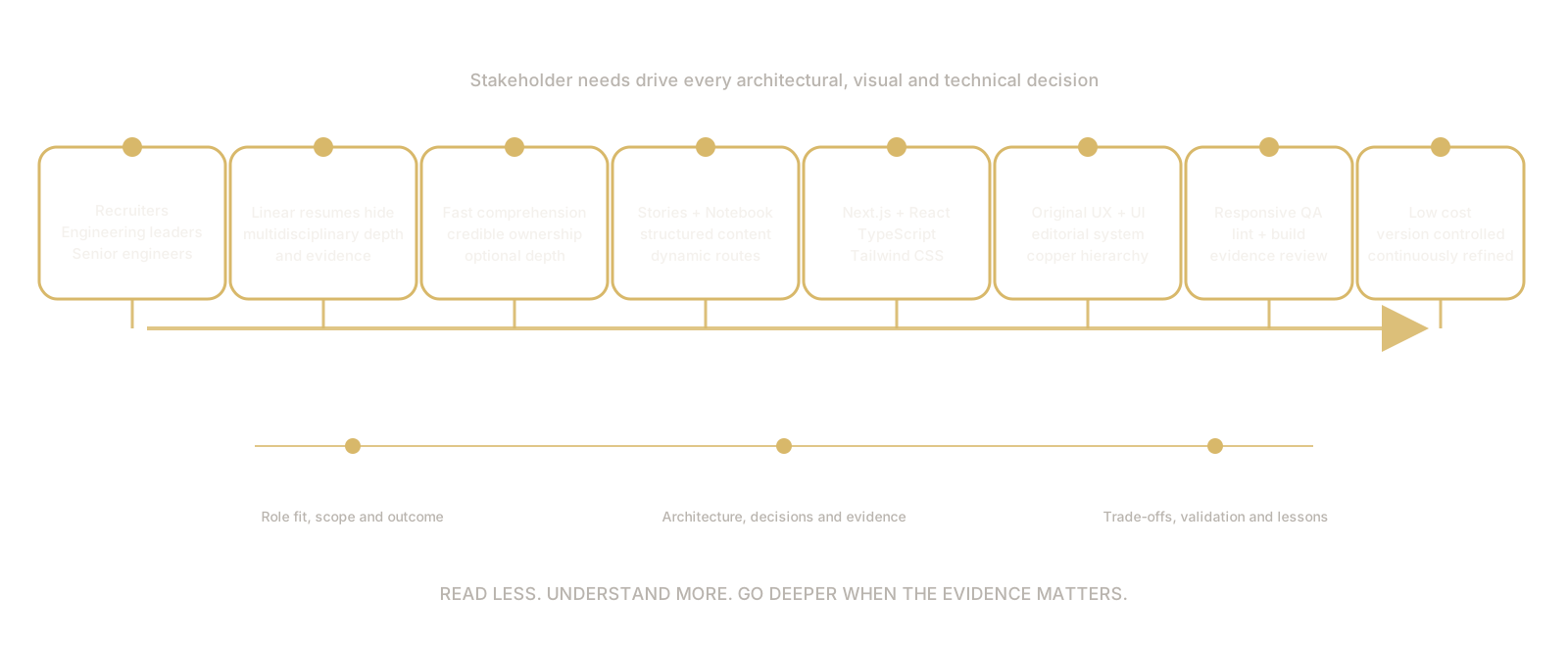
System development flow

From stakeholder needs to an operating product

The portfolio architecture followed the same sequence used in an engineering programme: identify the stakeholders, define the problem, derive requirements, select the architecture, validate the system and continue operating it.

Decision flow showing the engineering portfolio's progression from stakeholders and problem definition through requirements, architecture, technology selection, design, validation and ongoing operation.

Methods

Stakeholder-led requirementsDecision-led architectureEvidence-controlled editorial workflowResponsive validation

At a glance

My role

Product architect, UX/UI designer, editorial architect, developer and technical author.

Project objective

Create a credible, maintainable and public-safe system for communicating multidisciplinary engineering work.

Core stack

Next.js, React, TypeScript and Tailwind CSS.

Content architecture

Engineering Stories, Engineering Notebook and structured portfolio data.

Design approach

Original UX, UI and visual system.

Editorial approach

Evidence-controlled engineering narratives with contribution and IP boundaries.

Delivery approach

Branch-controlled, tested and incrementally released.

Infrastructure cost

Approximately US$8 per year under current usage and hosting limits.

Source links

Technology stack

Core application

Next.js

Routing, rendering, metadata and reusable page architecture for current and future editorial systems.

React

Repeated interface patterns for media, metadata, navigation, related content and interactive controls.

TypeScript

Typed content records for statuses, technologies, images, links, sections and metadata.

Tailwind CSS

Responsive states, spacing and design-token usage kept close to the reusable components.

Content and operation

Static and server-rendered editorial content

Fast delivery without a runtime database or application backend for the current publishing model.

Structured repository content

Version-controlled review of evidence, claims, source links, media and publication state.

Git workflow

Branch-controlled development with lint, build and diff review before accepted commits.

ChatGPT and Codex

Retrospective research, evidence reconciliation, editing, implementation assistance and review under human ownership.

Stakeholders came first

The portfolio was designed around reader needs rather than around a website template. Recruiters need role fit, seniority and career scope quickly. Engineering managers need judgement, ownership and delivery evidence. Senior engineers need architecture, trade-offs, testing and lessons. Hiring leaders need commercial impact, leadership breadth and credibility. I also need an accurate, maintainable and public-safe technical record.

A single resume-style page could not serve all of those readers well. The design therefore uses progressive disclosure: a 30-second skim for role fit, a 3-minute technical overview for architecture and decisions, and deeper narratives for readers who want evidence.

Recruiters

Role fit, seniority and career scope within seconds.

Engineering managers

Judgement, ownership, delivery evidence and communication style.

Senior engineers

Architecture, trade-offs, validation and lessons learned.

Hiring leaders

Leadership breadth, commercial relevance and credibility.

The real problem was not building a website

The real problem was communicating multidisciplinary engineering work without reducing it to resume bullets, overwhelming non-specialist readers or publishing confidential implementation details.

Traditional resumes are effective for linear career histories, but this career spans product architecture, electronics, RF, mechatronics, software, field validation, programme delivery and technical leadership. Compressing that breadth into short claims removes the evidence and reasoning that make the work credible.

  • Communicate professional positioning within seconds.
  • Show leadership and hands-on engineering without confusing contribution boundaries.
  • Separate commercial product stories from ongoing technical investigations.
  • Support rapid scanning and deep reading from the same system.
  • Preserve evidence without exposing customer, company or IP-sensitive material.
  • Remain inexpensive to operate and maintainable by one person.

Why a template was not enough

Templates were rejected because the content model and reader journeys were custom, not because custom code is inherently superior.

Generic portfolio systems can produce polished pages quickly, but they rarely model contribution boundaries, publication states, evidence-controlled project narratives, related technical notes and reader-specific depth. Those requirements shaped the architecture.

OptionAdvantagesLimitationsDecision
Hosted portfolio builderFast initial setup and low initial development effort.Recurring platform cost, limited information architecture, vendor constraints and weak support for deep engineering narratives.Rejected.
Purchased themeReduced front-end effort and prebuilt layouts.Generic structure, difficult long-term adaptation and likely mismatch with Stories and Notebook systems.Rejected.
Custom applicationFull control of information architecture, reusable content systems, visual identity and publication workflow.Greater initial design and implementation effort, plus responsibility for maintenance.Selected.

Major engineering and technology decisions

The central decisions were treated as product-system choices: each one had to support the communication requirements, reduce maintenance load or preserve publication control.

DecisionWhyResult
Next.jsStatic and server-rendered editorial content, structured routing, metadata control and future expansion without manually maintaining unrelated pages.Shared dynamic routes and reusable systems for Stories and Notebook entries.
ReactRepeated interface patterns for media blocks, metadata, navigation, related content and interaction behaviour.Design refinements can propagate through reusable components instead of being repeated by hand.
TypeScriptStructured metadata, publication states, technologies, images, links and narrative sections become harder to misuse as the project count grows.More predictable interfaces and fewer content-shape errors.
Tailwind CSSRapid iteration for a one-person project, responsive states beside components and controlled spacing/design tokens.Fast design iteration without a large disconnected stylesheet architecture.
Static/server-rendered editorial modelNo current requirement for a database, accounts or runtime application backend.Fast delivery and very low infrastructure cost.
Repository content rather than CMSOne principal publisher and every project requires evidence, contribution and IP review.Content remains version-controlled, reviewable and aligned with the design system.
Separate Stories and Notebook systemsCommercial project narratives and ongoing technical investigations need different structures.Stories demonstrate architecture, ownership and delivery; Notebook entries show investigation, experiments and evolving technical work.
Progressive disclosureDifferent readers have radically different available attention.Fast skim, structured overview and optional deep dive coexist on the same site.

Operating-cost discipline

Operating cost was treated as a design constraint. The goal was not to avoid all tools, but to avoid infrastructure complexity that did not improve reader comprehension, editorial control or long-term maintainability.

Current direct website infrastructure cost is approximately US$8 per year under existing usage and hosting limits. Hosting currently remains within a no-cost tier. Paid theme, CMS subscription and database costs are zero for the current architecture.

ChatGPT is a broader research, editorial and development tool, approximately US$20 per month, and is not counted as pure website infrastructure cost. Free-tier conditions can change, so the cost statement is a current operating-state snapshot rather than a permanent guarantee.

Design principles

Read less, understand more

Each page should answer the first question quickly before asking the reader for deeper attention.

Evidence before promotion

Claims are supported through project structure, decisions, images, source links or controlled narrative depth.

Multiple reading depths

One system supports skim, overview and deep technical inspection without duplicating content.

Responsive by default

Mobile, tablet and desktop layouts are treated as normal use cases, not a final cleanup pass.

Reusable implementation

Custom information architecture is implemented through shared routes, typed data and reusable components.

Public-safe technical depth

The site preserves technical credibility without publishing confidential implementation details.

Art and engineering developed together

The visual system was not applied after the engineering was complete. Content architecture, interface behaviour, imagery, typography and software structure were developed together as parts of the same product.

Artistic and editorial workflowEngineering and delivery workflow
Visual referencesRequirements and constraints
Story hierarchyInformation architecture
Typography and colourDesign tokens and reusable components
Image and media treatmentResponsive asset handling
Narrative rhythmStructured content schema
Interaction conceptsComponent behaviour
Diagram compositionTechnical accuracy
Editorial reviewLint, build and regression checks

Compact evolution timeline

  1. Positioning

    Defined the portfolio around product systems architecture, technical leadership and end-to-end product delivery.

  2. Information architecture

    Separated fast career navigation, flagship Engineering Stories and technical Notebook entries.

  3. Visual system

    Developed the dark industrial interface, typography, copper hierarchy, motion and media language.

  4. Application architecture

    Built the portfolio with Next.js, React, TypeScript and Tailwind using reusable dynamic routes.

  5. Canonical Story

    Published SmartRoller and used it to establish the reusable Engineering Stories design system.

  6. Engineering Notebook

    Created a separate architecture for technical investigations, hardware development and engineering records.

  7. Editorial governance

    Introduced evidence control, contribution boundaries, publication gating and IP-review workflows.

  8. Current phase

    Expanding project content, diagrams and related-content connections while preserving the established system.

Current state and pending work

Features remain deferred unless they improve reader comprehension, editorial control or long-term maintainability.

Completed

Professional positioning, custom visual and interaction system, reusable website architecture, dynamic Engineering Stories, SmartRoller canonical story, Engineering Notebook architecture, evidence workflow and responsive layouts.

In progress

Additional flagship stories, deeper Notebook entries, original technical diagrams, related-content connections, accessibility refinement and performance refinement.

Intentionally deferred

Paid CMS, database-backed content, user accounts, unnecessary analytics complexity, high-maintenance effects, paid hosting infrastructure and features without a demonstrated reader or maintenance benefit.

AI-assisted, human-owned workflow

Generative AI supports historical reconstruction, editorial organisation, implementation assistance and review. It does not originate the engineering projects, professional experience, design judgement or product direction.

Raghav remains the product owner, design authority, technical decision-maker, evidence controller and final reviewer. AI-assisted changes are kept inside repository governance: scoped prompts, diff review, lint, build and human acceptance.

Limitations

  • Cost figures describe the current operating state and hosting limits, not a permanent guarantee.
  • The entry publishes public-safe summaries rather than raw evidence records or internal review material.
  • Additional screenshots are intentionally omitted; the live website is the artefact.

Next steps

  • Continue expanding flagship Engineering Stories and deeper Notebook records.
  • Add only diagrams or media that improve reader comprehension or evidence quality.
  • Keep publication status, contribution boundaries and IP review visible in the editorial workflow.
  • Review accessibility, performance and content relationships as the archive grows.

Related notebook entries

Related stories